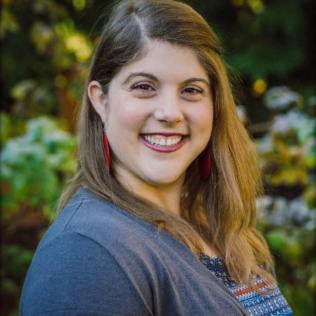
 Tell us a little bit about yourself – who IS Leslie, what is your life story? Okay, maybe not your whole life story…
So I’m Leslie Conzatti. I live in the Pacific Northwest, and I work full-time as an elementary school paraeducator. If you don’t know what that is, we’re also called “staff assistants”, and we’re the ones who support the teachers in the classroom, lead small groups of students from every grade level in subjects such as math or reading, cover crossing guard duties, and playground/cafeteria supervision. (So yeah, busy days! But I love it!)
As for writing, literature has long been a passion of mine. Before I could read, I was making up stories about the pictures I saw in different novels. Being homeschooled, classic literature was never far from arm’s reach during my whole childhood. We would visit the library regularly, and load up on books–I would challenge myself to read through the entire box as quickly as I could! I started writing stories around the age of eight, getting more serious about it when I was in my teens, and by the time I was in college, I was writing pretty much nonstop.
How long have you been writing? Did you ever have an “a-ha” type of moment where you knew, “Hey, I need to publish this!”?
Well, I guess I already answered this above, but I would say I’ve been writing nonstop pretty much since 2010.
In 2013, I started a blog, “The Upstream Writer”, where I would post my thoughts, reading lists, book reviews, and excerpts or serials of stories I either had already written or was writing fresh for my followers. (Six and a half years, and still going strong!) This was probably the experience that got me comfortable with sharing my work with others, and it was a lot easier than trying to print things out and hand them to friends!
My publication journey didn’t happen like an “a-ha” moment… it just happened. I was in a group of authors on Facebook, and we all kind of knew each other, when, back in 2014, one of the members suggested we produce a group anthology, consisting of “fairy tales with our own unique spin on them.” I was all excited–especially since I had a fanfiction that was at least halfway my own rendition of Disney’s The Little Mermaid. All I had to do for the anthology was take the parts that were the sections of the fairy tale, change the character names from copyrighted ones to original names, fill in the gaps where I had been telling the secondary story for the fanfic, and there we have it! A year into the project, the idea of a self-published anthology fell through, but one of the group members ran his own publishing business and volunteered to take over the publication of it. There were only a few takers left by then, including myself, and a year later, when the deadline arrived, I was the only one who could still submit on time. So rather than publish an anthology, this excellent gentleman ended up publishing my “submission” on its own, and in late 2016, Princess of Undersea was born!
In 2017, I published a short story, “Arthur and The Egg” (a sort of contemporary urban fantasy re-telling of “Jack and the Beanstalk”) in the anthology Dreamtime Dragons. In 2018, another short story, “The Starborn Legacy”, was published in the anthology Drowned In Moonlight, a charity project dedicated to the memory of Carrie Fisher, for which all proceeds would go to benefit the International Bipolar Foundation. Later that year, a third short story, “Heartsong” was published in the anthology Cracks in The Tapestry. This makes Forest of the Fearless the fourth anthology to contain a story written by me, and I don’t intend to stop or slow down anytime soon!
How many unpublished and half-finished books do you have?
Oh dear… Well, let me put it this way:
On my blog, there is a tab called “The Shelf”, where I wrote up all the unfinished projects and idea starts that I had a premise for, but not the time nor the technical know-how (which would require additional research time) to write at the moment.
There are 21 titles listed on this page. Of that many, 2 are actually “finished.” (but unpublished) So that makes 19 ideas that I’ve either “completed” and they badly need a rewrite, or I started but haven’t yet finished, or I haven’t started at all.
Then there’s the tab called “The ReBible Series.”That was an idea I had back when I was still in college, of writing up different stories from the Bible, like David, Daniel, Joseph, and even Luke, in contemporary settings, maintaining the integrity of the original story while not neglecting to make a genuinely good novel out of it! For example, the story of Ruth is set during the 20’s and 30’s, as Ruth is an African-American chanteuse in Harlem, where she meets the son of a wealthy plantation heiress, marries him, and becomes part of the family. The Depression hits, and the heiress, her white mother-in-law, must return to the family plantation in the Deep South, in order to save it from being repossessed by the bank–so Ruth goes with her and the two women must overcome race and gender barriers to save the one place they can call home. Or Joseph is reimagined as a military fiction novel, where he is the newest recruit in an elite unit tasked with preventing a coup in the Middle East–and instead of being able to interpret dreams, Joseph has a knack for codes and languages. Daniel is a near-future cyberpunk story, with the nations of Israel and then Babylon reimagined as a small business being overtaken by a monstrous corporation, which makes Esther a future continuation of that, even more of a dystopian cyberpunk novel.
So you see, I’ve got solid ideas for at least 10 different novels, all based on Bible stories. So that brings me up to, what, a total of 30 or so? That’s not even counting the short stories I haven’t finished yet… and there are more ideas happening in my head all the time, so it never really ends!
How do you cope with writer’s block?
Writer’s block? Is there such a thing? Actually, there is… I very clearly remember experiencing it on at least two occasions. Both times were really similar: I was in the middle of writing a story and things were humming along until I hit a snag in my writing, and I knew what was going to happen later on, I just needed to figure out how to move the story from where it was currently to where I wanted to eventually end up.
Then the voices just stopped.
Most of the time, when I have a story idea in my head, it’s like a movie playing in the background constantly. I can hear the voices of my characters at any given moment, but it’s when I stop and I really focus on it that I begin to see it visually unfolding in my head. When I had writer’s block, my mind was just silent and empty. It was the creepiest thing ever and I hated it. One time it lasted about two months. But then an epiphany happened and I knew exactly what I wanted to do.
I still experience bouts when I just don’t feel like writing. There are still the voices, but the motivation isn’t in my hands to get it all down. In those times I find that I typically start “craving” media that would help me with the issue, whether it’s a book, a movie, or a TV show, and typically after watching a few of those, my brain has sorted what it needs to, and I can resume writing.
There is a quote that I saw somewhere, I forget who said it: “Reading is like breathing in. Writing is like breathing out.” I don’t want to “hold my breath” too much (reading without writing) any more than I want to “hyperventilate” (write too much without reading). My writing usually suffers when I stop reading, anyway, so that’s usually my cue that things are out of balance and I need to take a break from one activity to engage in the other.
Tell us a bit about your story in the Forest of the Fearless anthology?
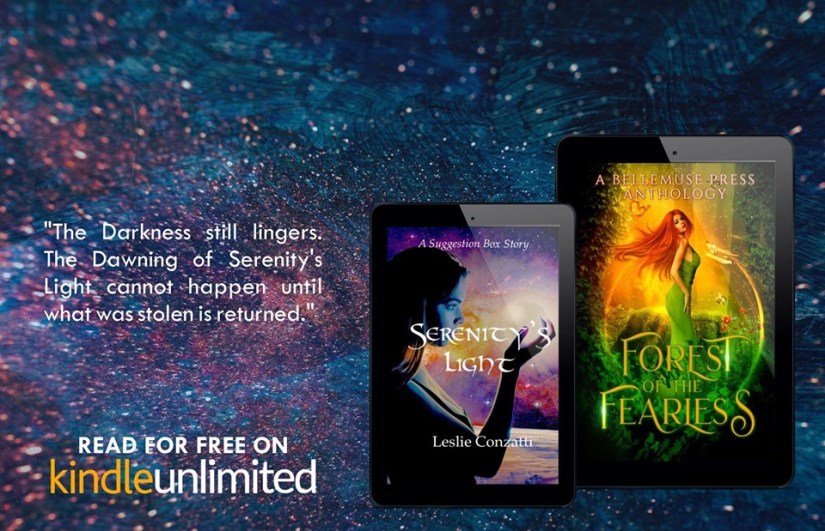
“Serenity’s Light” follows the story of two characters from two different dimensions.
It starts with Nerissa, a Fae from a magical dimension whose world has been plunged into darkness when evil enchantment causes Serenity–the star that gave them light much like our sun–to vanish from the sky. She travels into the Forgotten Forest to find the answer to the rhyme that has puzzled the Fae for generations–and she finds a part of it, but she must travel to another dimension, one far less permeated by magic, to find where the other pieces have gone. In its fractured form, Serenity has taken the appearance of three magical items: a sword that gives the bearer extraordinary fortitude and strength (which she has), a collar that can restore memories that have been lost as a result of magic, or magically erase existing memories over a certain period of time, and a crown that grants whoever touches it immortality. She enlists the help of another Fae to not only search for the other artifacts, but also watch for the evil forces intent on gathering the power of Serenity for themselves. Through portals from the magic realm, they can access various points throughout the history of this other dimension, known by its inhabitants as “Earth.” While her friend seeks after the dark forces, Nerissa must also locate the one known as “the Lore-Master,” one with vast knowledge of ancient things, who is the only human who can wield all three artifacts and restore Serenity’s Light to its rightful place.
On Earth, a history professor named Kenneth travels to a remote island off the coast of Ireland, in search of his wife, an astrologist who disappeared two days prior. He finds her, at last–but she has no memories of him. Desperate to reunite with her, he learns of an ancient necklace that can restore memories, so he embarks on a quest that places him squarely in more danger than he ever thought possible, against forces that he never dreamed existed, and a destiny he never knew he had.
Who will succeed? Will Kenneth be able to restore his wife’s memory before Nerissa claims all three artifacts and finds the Lore-Master? Or will both of them be outwitted by Time Itself, while the work of evil claims the spoils and rids the Fae world of all light forever?
Without spoilers, what was one of your favorite scenes to write?
That’s a good question! There were a lot of fun scenes to put together–a seventeenth-century Viking and a Wood Sprite having their first experience wearing contemporary street clothes, the scene where an old woman who received a gift and a letter forty years prior finally meets the people it was intended for when they show up (with an unconscious Viking) in her back yard… When an innocent museum curator realizes that these strange packages she received years ago to display at the museum are actually magical artifacts from another dimension… When I was able to work in a “special appearance” of two characters from a completely unrelated flash fiction piece and give them important roles in this story… and most of all, when I was able to take two stories that didn’t seem related at all… and tie them irrevocably together!
Which character do you relate the most to? Are there any real-life people who have inspired characters in either Serenity’s Light or other books?
Hmm, it’s hard to choose! I’m a little bit like Nerissa in that I fight to maintain the ability to see the good in life, to “cling to the light” as it were, even when everything around me is dark, and so many people either have no idea what’s coming, or they are actively working against me. I’m also a little bit like Agnes–I’ve spent a fair chunk of my life thinking that something was going to happen, living each day with the expectation that we’re getting closer to something… But at the same time, I can’t shake the feeling of “what if I get too old and it hasn’t happened yet?”
I relate to Kenneth because of the way he just tries so hard to put everything together, but it seems like with every solution comes a whole new set of problems, and what can he do about it?
I relate to Sarah, who had strange things happen to her with absolutely zero context, and she’s tried to put it off in favor of a normal life–but her life keeps encountering twists that make it anything but normal!
That’s the beauty of writing, I think–a little bit of ourselves goes into each character–all the distinct traits that make us unique!
As for real-life people who have inspired different characters… That only happens to me occasionally. I’ve been known to “headcast” some of my stories. Can’t say whether I did that with “Serenity’s Light”, but sometimes, there are people whose personalities just come out so strong, you can’t help but put them into your story!
What advice would you give an aspiring author, both in the indie community and outside of it?
There are several things that I feel a writer must heed if their stories are going to exist. I’ve written a couple blog posts under the title of “How To Book”, which details how a person who desires to be a writer should approach the craft of writing. For now, though, I’m just going to call out on a couple traits I’ve seen cropping up way to many times recently.
First of all, don’t quit unless you never intended to be a writer in the first place.
Too many times I see “writers” throwing in the towel at the first criticism, at the first inkling that there might be one or two other stories “exactly like mine dear jeebus what do I doooooo???” or even the moment the plot hits the tiniest snarl for like five minutes! If you want this story to exist, it must mean it doesn’t already. If you’re fine with someone else’s story existing instead of yours, then don’t even go there. If you’re not committed enough to seeing this story through all of the bumps and twists and snarls and blocks… Well then, it must not mean all that much to you, so you’re better off without the headache and the heartache!
If this offends you to your core–then don’t ever quit because that means you are a writer and you are going to stick with that story clear to the end because by jingo it needs to exist!
I just had a reader inform me of three tiny typos in a story I’d written (just three! I’m ecstatic!) and also that she didn’t like the way my story jumped around a lot (hazards of time travel, no big deal) and that it felt too rushed and she “hated the ending.” (Well! Slightly less elated…)
Did it hurt? Well, yes, a little.
Did it make me want to give up writing altogether? Heavens NO. I happen to trust that I ended it the way it should have been. I honestly would not have written it any differently, not even for this person. There will be “haters” in every audience, the ones who see fit to criticize just because something doesn’t suit them. That doesn’t make it bad. You want to know what bad writing is? The kind of writing that just sucks all the joy out of your life. The story that makes you feel all icky and nasty when you read it. The one that isn’t edited at all and there are errors on every single page (and considerably more than just three words in over twenty-six thousand), the one that is a blatant verbatim rip-off of an existing book, or the one that just doesn’t make any kind of rational sense at all. If your story fits any of these things, then keep working at it till it doesn’t. If you can look at your own work and say that none of the “qualities” I’ve listed apply–then boo to anybody who tries to tell you otherwise.
Keep writing. That’s the only way you’re ever going to get better and overcome the challenges you’re facing. You might miss eight out of ten hurdles in a race if you try your best, but you’ll definitely miss ten out of ten if you never leave the starting line. So jump those hurdles. Give it all you’ve got–and if that’s not perfect, well then, keep practicing and try again. You’ll get there eventually if you just keep going.
Second of all, Forget perfection–Practice makes progress. You might feel like you’re at the top of your game and you don’t need to listen to any advice ever, or conversely, you might refuse to do things like read other authors in your genre or rewrite a rough draft more than once or twice because you don’t want to get the “wrong ideas.” But honestly, that’s the only way you’re going to get any better is by doing both those things! Some amateur writers make the mistake of thinking that reading the same genre as the book they want to write is going to “pollute my natural voice.” But at the same time, writing is not something they do outside of that one project, so there’s no room for this “voice” to actually mature and develop. There was a book I read once (that was apparently the second book that person had published) that was so bland and really detached from reality that the very responses to peril from the characters felt stiff and unnatural, and not one was relatable or even distinguishable from the rest. Was I surprised to find that this author prided himself for refusing to read books in that genre because he wanted “his voice to be his own”? I was not. It was definitely “his voice” because I couldn’t connect to the story in any way!
Don’t be like this. The truth is that you really should read more if you want to write better, and you should read widely. Don’t exclude any genres, because that way, if you’re really scared of one writer or another’s style seeping in–you’ll be too inundated with multiple styles to actually replicate any one particular one…. and in that cacophony of writing styles and input, your voice will necessarily be a blend of the ones you like the most. And most of all, it will be yours. No joke, I found my voice through writing a bunch of fanfiction and doing my best to imitate the “voice” of the original writers. And I found the confidence to imitate them after reading a bunch of books either by the author, or along the same lines as the stories I wanted to write. So keep practicing, allow yourself to look for ways to improve and get better, and read and write a lot to get better!
What is your favorite fairytale?
I like different fairy tales for different reasons!
I love tales like Cinderella and Beauty and The Beast because they are “ordinary” girls who made the virtuous choice and were rewarded for it.
I love Peter Pan because of the enchantment of Neverland.
I love “The Little Mermaid” because mermaids are my second favorite fairy tale creature. I love any tale that contains dragons because they’re my absolute favorite fantasy creature. (Unicorns are third, by the way.)
What is ONE thing you want your readers to know?
Aww, do I have to pick just one?
Okay, we’ll go with what is quite possibly my favorite quote of all time, and one that regularly inspires my reading. Ironically, it comes from Fahrenheit 451 by Ray Bradbury, a book that tells of a dystopian future where books are banned and even burned on the spot when found, because of the wealth of knowledge they contain, and the free and unfettered thinking they encourage in their readers. (The very idea!)
The quote is this: “Good writers touch life often. The mediocre ones run a quick hand over her. The bad ones ravage her and leave her for the flies.”
It is my goal and my passion to be a “good writer” and I realized, after this quote had stuck with me for a long while, that the best stories are the ones that touch life often. They’re bursting with relatability and common ground with the reader–any reader–because they stay in very close and intimate contact with real life, while at the same time transcending it and moving beyond the real and into the potential future. It doesn’t matter what genre you’re writing, whether it’s a fantasy in another dimension or a sci-fi on a far and distant planet–the good writers touch life often. Those are the writers worth supporting, the books worth reading. Don’t settle for a mediocre one, and I certainly hope you never come across any books by an author who doesn’t care about real life and real emotions, instead forcing and slapping together and generally making a disaster of a story. Go for the stories that touch your life, and you’ll be a better, smarter, happier person for it!
 Serendipity Minds